Introduction
If you are in the software industry and haven't started working with an AI assistant by this point in 2026, then you should start getting concerned about your role in the company you work at. Throughout the first few months of 2026, there have been several large layoffs by major corporations. Companies like Block and Oracle cited AI as the driver.
AI is here and as of today, it's the least capable it will ever be, because each day it gets better. I've been exploring it since ChatGPT came out and it's impact on interviews. I've written about it multiple times recently. AI's impact on junior developers is particularly important because I'm already seeing this in my role.
My teams have been utilizing a handful of AI assistants over the past year and making amazing improvements to our workflows. From things as simple as reducing the SDLC cycle time for major features to triage of support items, the impact has been dramatic.
I feel like I've only touched the surface - not even scratched it - touched the surface of how to better use AI tooling, and I've been using it a lot. So, I looked for a workshop to increase my knowledge. As a subscriber to Real Python, I was happy to see they offered a brand new workshop about Claude Code and as of this writing they are offering it again.
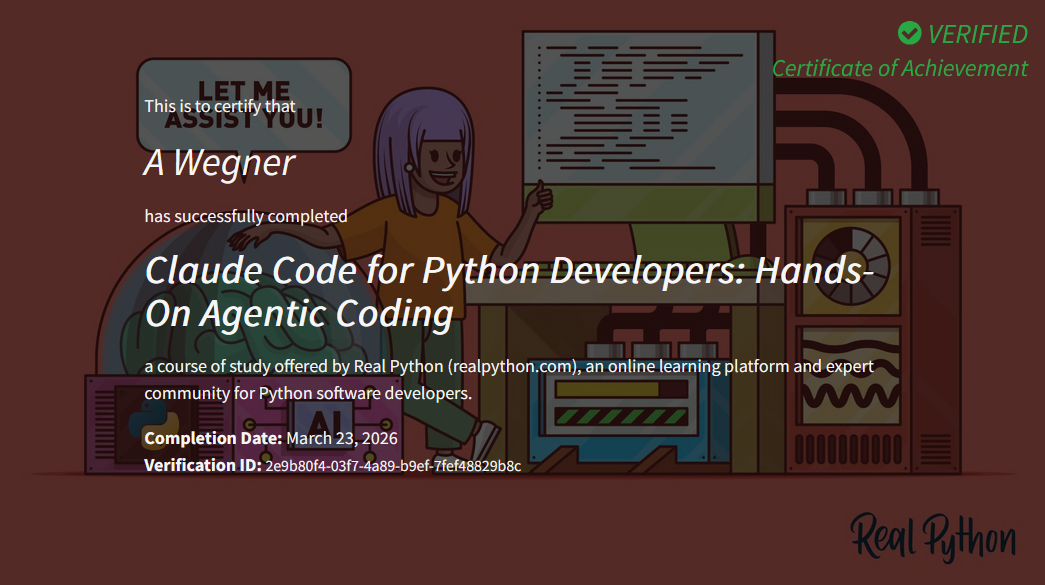
The course - Claude Code for Python Developers: Hands-On Agentic Coding Course. A bit wordy, but an amazing two days.
Spoiler
As a spoiler, my review of the course is on the main course page.
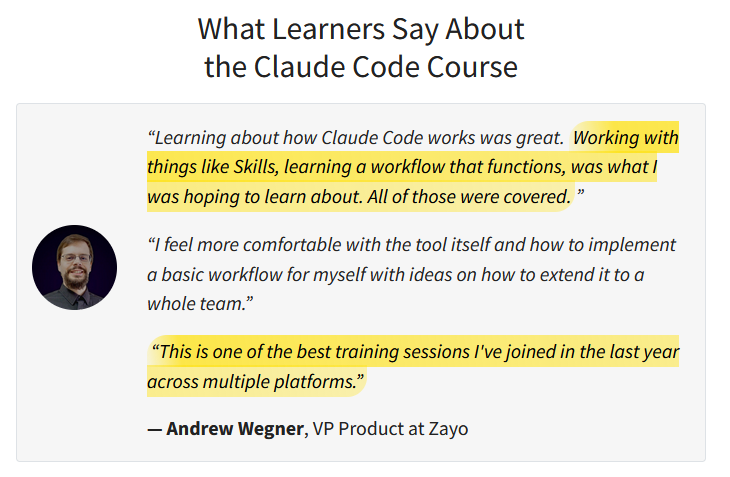
"Learning about how Claude Code works was great. Working with things like Skills, learning a workflow that functions, was what I was hoping to learn about. All of those were covered."
"I feel more comfortable with the tool itself and how to implement a basic workflow for myself with ideas on how to extend it to a whole team."
"This is one of the best training sessions I've joined in the last year across multiple platforms."
— Andrew Wegner, VP Product at Zayo
Course
As you can see from above, I thought this course was great. It was a two day (over a weekend) live course with about 100 participants from around the world. Based on the chat during the course, the skill set of participants ranged from "new to Claude code but experienced developer" to "somewhat familiar with Claude Code and looking to do more with it". It was a nice mix of participants. The instructor, Philipp Acsany, did a good job of answering questions, sharing content, and ensuring everyone was able to follow along. This was a very hands on workshop.
Before the course began, set up instructions were sent out. I can not overstate how much this was appreciated, because that meant the course could assume that everyone has a functioning environment to work in. This saved so much time on basic questions and allowed the course to start with the interesting content, not a tutorial on how to install Claude Code, GitHub CLI, Python and uv, Git and Zoom.
Day 1 started with the very basics of Claude. Normally, I'd be annoyed by starting with such a basic concept, but Philipp kept it engaging and more importantly, showed some best practices using Claude to scaffold a new project that I hadn't seen. Thinking that this bodes well for the rest of the course, I eagerly followed along.
As Day 1 moved on, we built upon our scaffold to develop a small application, learning how to manipulate various aspects of claude, setting up prompts and skills to assist our workflow and learning how to debug when something doesn't work. Day 1 concluded with a little bit of homework. After 4 hours in the workshop, I felt pretty confident that I could accomplish this and was happy to see that confidence was justified. After about an hour more of individual work, I completed the tasks and was ready for day 2.
Day two built on top of the homework by adding in additional features, ensuring we were able to utilize various skills, and learning more about how Claude operates under the hood. The session concluded with quick demos of additional aspects of Claude - hooks, MCPs, and Agents. Honestly, this was my biggest disappointment in the course, because it showed so many things we wouldn't be getting to, but it did fill my "research later" queue.
Conclusion
This isn't a cheap course. But, it was worth it to me. I approached this with two goals in mind:
- Learn something for myself that I could take and apply to personal projects
- Learn something for my teams so that we could use it as inspiration to make further improvements to our workflows
Both of these were met in Day 1. That made Day 2 even more fun for me, because I showed up wanting to learn more, cover more, do more. As I said in my review on Real Python: This is one of the best training sessions I've joined in the last year across multiple platforms.
Through out the course, student questions were responded to - both live via Philipp and in chat via one of Philipp's partners or from other participants. I found this aspect of the course really valuable too. I did get a handful of questions answered during it, but I was able to provide answers as well.
So, why did I only give this a 9 out of 10? What's preventing that last star?
There are aspects of the course that were touched on so briefly that I think would have been useful to dive into. These are the topics that have ended up in my research queue - hooks, mcp services, agents, agent teams. I think these could have filled another 4 hour block, but this was a weekend course and didn't fit. I'll be watching for a session that covers these topics.
The other thing - the cost can be prohibitive to students. There is the cost of the course itself: $800 normally, $500 on sale when I joined. Plus the cost of Claude. It is recommended to get at least the Max plan which runs $100 per month. I agree with that. I think if I'd only gone with Pro, I'd have hit usage limits during the course.
That said, if you can afford it (or get work to cover it as training), this is worth it for both an introduction to Claude Code and to learn about features you likely aren't using to their full power. Even with this course, I don't think I am doing that yet, but I know what to research now to get better for personal usage and for team improvements.